
Easy Step by Step Guide: How to Set Up Your New Life in the UK
If you’re moving to London or the UK, or have just moved here, there’s an unfortunate reality once you arrive: you’re really starting over from scratch.
But to leave your old life behind, you have to set up your new one. It’ll take some time, especially since you’re learning the systems of your new adopted country.
Here’s my complete guide for everything you’ll need to do to get your fresh start off to the right start.
I’m an American who has moved here to the UK (twice!), and I’m going to explain everything you’ll need to do, when you need to do it, and how to accomplish it easily.

Please Note:
This list assumes that you already have your Visa approved, and have temporary accommodation sorted. If not, check out my complete guide for everything you need to do to move to London and the UK right here.
Before You Arrive
If you can do a few of these important tasks before you set foot in the UK, it will make your life a whole lot easier once you arrive.
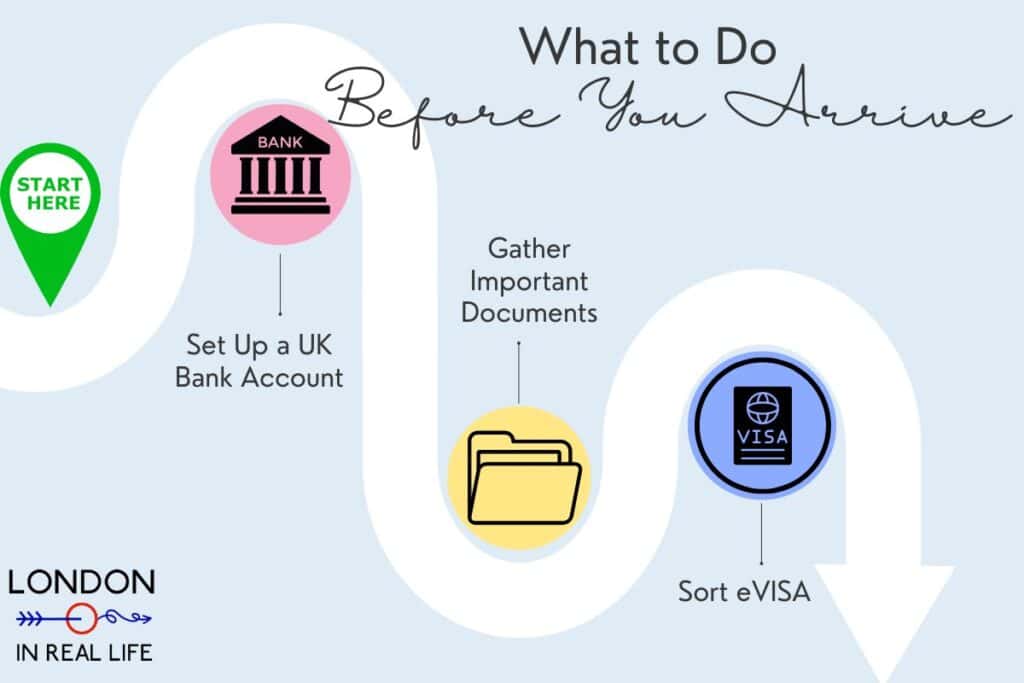
Set Up a UK Bank Account (If you can)
The UK has strict regulations on foreign investors, and you can’t rent or buy a property without a UK bank account. This should be your first priority.
In your home country, see if there are any banks that also have branches in the UK (HSBC is one international example, though there are others depending on where you are).
Put enough money in that account to pay for at least a few months rent, or else you will need a guarantor to rent a property.
Here’s the catch-22: you can’t rent without a UK bank account, but you can’t get a UK bank account without proof of a UK address.
To set up a local bank account, you’ll need:
- Your passport, and any Visa documentation you have (to prove that you will, in fact, be a resident in the future).
- Proof of address: either your temporary accommodation address or your office’s address will sometimes be accepted, though it varies bank to bank.
- Proof of income: payslips, tax returns, or a letter from your employer guaranteeing your income.
Always check with your bank’s individual requirements to make sure you have everything you need.
Gather & Store Important Documents
To set up your new life, you’ll need all your ducks in a row. Scan and keep copies of all these important documents so you will have them handy when you need them:
- Birth Certificate (original and certified copies)
- Marriage Certificate/Name Change Paperwork
- Copies of Passports
- Visa paperwork & approval documentation
- Medical, dental & vaccination records (get these before you leave your home country)
- Tax & Employment Records
Get a small accordion-type folder to keep in your carry-on for essential paperwork.
For digital documents, I use the TurboScan app, so that all my documents are in one place and don’t get lost in my camera roll.
Sort Out Your eVisa or BRP
The UK is in the midst of big changes in proving your immigration status. The old BRP (Biometric Residence Permit) cards went away at the end of 2024, and are being replaced with an eVisa.
The new system allows immigrants to prove their immigration status with an app, but you’ll need to set it up in advance through your immigration account.
Once you’re set up, you can download the UKVI app to access your eVisa.
There are sometimes glitches in the new system, so make sure it’s all running smoothly to avoid any trouble at immigration.
After You Arrive

Get a UK Phone Number & Mobile Data
You can’t do much without a UK phone number or mobile data.
There are two types of mobile options here:
- Pay-as-you-go, which you can purchase at many convenience stores (either for a physical SIM card or an eSIM) or phone shops. This will give you a phone number and a set amount of mobile data that you can top up once you run low.
- Mobile contracts, which are often cheaper than pay-as-you-go in the long run, but can’t be purchased without a UK address and bank account.
What we’ve done in the past is purchased temporary SIMs when we landed, then signed up for a mobile contract once our permanent address was secured.
You can also purchase a UK SIM or eSIM before you arrive online, so that you have data the moment you land.
When you switch to a more permanent mobile plan later on, make sure to change your phone number with any accounts you have previously set up using your old one.
Collect & Document Important Numbers
Like a social security number in the US, the UK has some crucial identity documentation you’ll need to locate and keep track of.
- Get Your National Insurance Number
This number is for tax purposes, and you’ll need it for filing your UK taxes later on. If you are coming with a job offer, your employer will usually secure this for you. If you’re self-employed or on a spouse Visa, you’ll need to apply on your own.
This is your unique ID within the NHS. It will have been assigned to you when you paid the Healthcare Surcharge during your VISA application.
You don’t have to have it to access medical care, but it makes things easier if you do have it.
- Get a Right to Rent Code
You’ll need to get this share code to use in your property rental application. It proves to estate agents that you legally have the right to rent a property in the UK.
Start Your Property Search
The longest and most grueling part of your move will be your property search, and this is especially true if you’re moving to London.
Start as early as you can, and ensure you have plenty of time booked in your temporary housing.
Read more about the basics of property hunting in London here, and my best tips for working with the dreaded estate agents here.
After You Have Your Permanent Address

Register for Council Tax
Go to your borough’s website and set up your council tax account. This pays for essential services like rubbish collection, libraries, road maintenance, et al.
You’ll need your council tax bill as proof of address in many cases.
Set Up Utilities: Water, Energy & Internet
Council tax doesn’t cover things like water and electricity. Along with your lease, you’ll get a list of the utilities you need to create accounts for.
The UK is a bit different from other countries in that you can choose your energy supplier, though (at least initially) it’s easiest to go with whatever energy supplier is currently serving your property. Use this search tool to find out who it is.
Gas and electricity are served by one supplier here, unlike the US where you have two different companies handling these services.
There are also several different internet providers depending on where you live. The big ones are Sky Media, Virgin, and BT.
Secure Renter’s Insurance
There is no legal requirement to have tenant’s insurance in the UK, but you need it. Renters have very little recourse, so it’s always a good idea to be protected.
Register With Your Local GP
Your GP – general practitioner – is your gatekeeper to healthcare. They’re in charge of everything, and finding a good one is vital.
Research the GP practices nearby, ask around, and choose one with good reviews. On their website, you can register and provide proof of address to ensure you’re in their catchment area.
After you’re registered, you can (in most cases) communicate with them through the NHS app.
Provide them your medical records, and if you have children, ask them to check that your child is up to date with the UK vaccine schedule.
Research & Apply for Schools
You can’t apply to state (public) schools without an address, and they all have different catchment areas.
Ask your neighbors about the reputation of the schools nearby, then apply through your borough’s website.
Independent (private, fee-paying) schools do not have a catchment area, and you’ll apply to each of these schools individually.
Get a TV License
You need a TV license in the UK, even if you only use streaming services. This is a yearly fee, and you can get a large fine if you don’t pay.
Ongoing Tasks
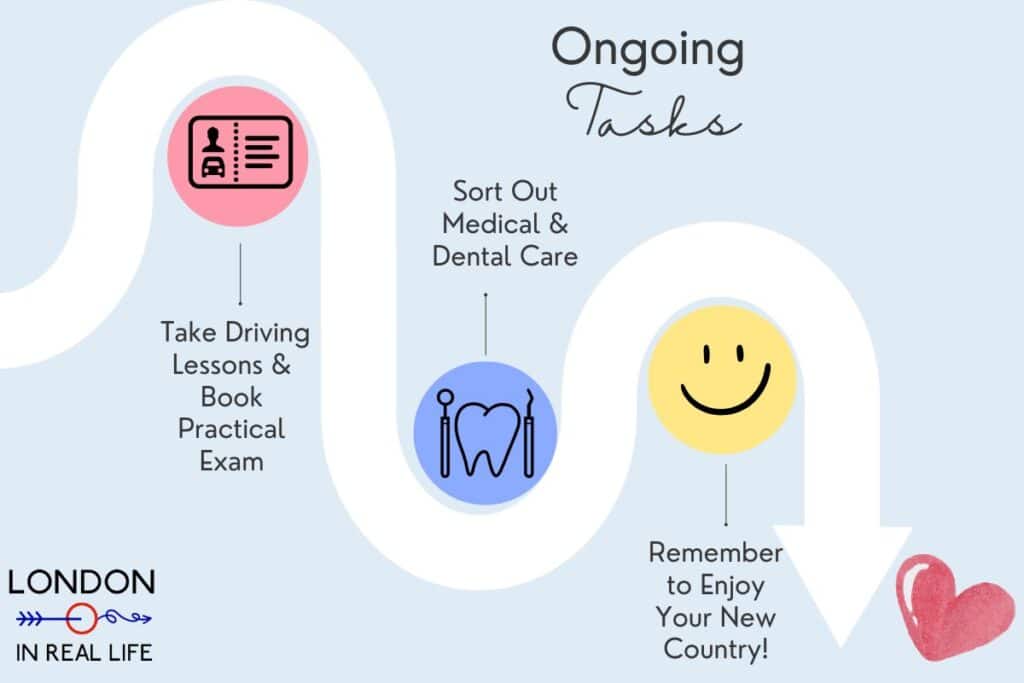
Driver’s License
Depending on where you’re coming from, you may be able to drive in the UK temporarily on your current license while you apply for a local driving license.
Driving here is more intense than most places: the tests are extremely difficult, and you WILL need lessons beforehand to learn how to pass the test.
I know many, many American drivers who have taken and failed the test multiple times, and it’s not free to take!
If you’re moving to London, you generally do not need to drive, and I don’t recommend buying or renting a car – there is no place to park, and public transport is much, much faster and cheaper.
Healthcare
Pharmacy
Choose a nominated pharmacy through your NHS app where your GP can send your prescriptions. There are high street pharmacies or mail order ones, but you can only choose one option.
I use a high street pharmacy because if I need a prescription fast, it’s the easiest and quickest option.
Dental Care
Many dentists work within the NHS system so you can get free cleanings, but not all of them have room for new patients.
If you can’t get into an NHS dental practice, private dentists are a great option and fairly affordable. Some use a membership system where you pay a flat annual fee that includes cleanings and checkups.
Optometry
The NHS doesn’t provide eye exams in all cases (check your status here). Most optometrists have free or low-cost eye exams, and you can get glasses on site from about £99.
Remember to Enjoy Your New Country!
With all the to-dos and stress, it’s easy to get bogged down in the minutia. Don’t.
Remember why you made the move, and go do something fun amidst all the chaos.
If all else fails, get away for a quick weekend escape to recharge.
Questions? Feel free to contact me! I know how confusing this whole process is, and I’m here to help if I can.
Life in the UK isn’t always easy, but we’re in it together.
Read More: Moving to London & The UK
Complete London Neighborhood Guide
Finding Short Term Accommodation In London
How to Rent a Property in London
Navigating the London property market as an expat
What to pack (and what to leave behind)
Tips for shipping belongings internationally


