
Finding Flats in London: 11 Secrets Estate Agents Don’t Want You To Know
As an American who first moved to London over a decade ago, I’ve searched for more than my fair share of rental properties.
The London rental market is very, very different from most other markets, and is more difficult than even our American equivalent of New York City.
I just finished a grueling 4 month property search, and though I hated every minute of it, I came away with some important tips and tricks.
I’ve spoken to over 150 estate agents this year (not counting all my previous property searches), and each one taught me a lesson, for better or for worse.
Here’s what I’ve learned about finding flats in London, so you can make your property search the tiniest bit less stressful.
1. Estate Agents Don’t Care About You One Bit

Estate agents don’t work for you. They work for the landlords and their agency. Their job is to find someone qualified who can pay the rent. You are a paycheck for them, and nothing more.
Unless you’ve hired an agent of your own, an agent is like a used car salesman: a necessary barrier between you and the object of your desire.
And like any used car salesman, what they say is not what they mean. Learn to read between the lines, and take everything with a grain of salt.
That’s not to say that every estate agent is sleazy. Not all of them are, and I’ve dealt with some downright pleasant ones. But it’s not a profession that exactly attracts polite, demure personalities.
Tip: Be as bold and brash as the agents themselves. Tell them exactly what you’re looking for, and don’t waste time seeing properties that don’t fit your criteria. This is a cutthroat game, and you have to play to win.
2. By The Time They’ve Listed a Property, it Might Already Be Gone
By the time they’ve listed a property on a website (or by the time you’ve seen the listing), it may already have an offer or two.
They won’t take the listing down until a rental agreement is signed and a deposit is paid. They want as many applicants and offers as they can get, to fetch the landlord the best price.
That whole process – from offer to acceptance to rental contract – can take days to weeks. All the while, the listing still sits there, attracting applicants.
That perfect property you have your eye on, and you’ve been waiting to hear back about? It’s probably already gone, or there is at least someone farther along in the process than you are.
If they’re not returning your calls or emails, that’s not good news.
Tip: Stay flexible, and keep several irons in the fire. Don’t get your heart set on any one home that you’ve only seen online.
3. Clickbait on Rightmove is Very Much a Thing

According to my current tally, six properties I inquired about in the last few months – and heard directly from the agency that were already “let agreed” – are still listed, even months later.
Why? They got a good response to the photos, and are using it as a faux-rental to attract new clients.
You’ll contact the clickbait property, and the agent will say, “that one is no longer available, but I have x, y z still on the market, if you’d like to see those?”
If it looks too good to be true, it is. If it’s been listed for a long time (properties hardly ever stay vacant), there’s either something very wrong with it, or it’s a fake listing.
Why do they do this? They want your contact info, to talk you into a property that’s not exactly what you’re looking for.
Tip: Reverse image search to uncover the property listing history. Has it been listed multiple times this year? It’s clickbait.
4. Beware of Cold Emails and Calls
Got a cold email from an agent? Be wary.
The only time they need to actively solicit clients is when they have a property that’s vacant and not renting. There’s something wrong with it: the price is outrageous, it has no living room (yes, seriously), the neighborhood is in a transport desert, it’s above a nightclub, etc.
Be very, very cautious if an agent reaches out to you. They don’t work for you, and their intentions are just to get the property occupied, no matter what.
Tip: An estate agent’s dream client is hopeless, desperate, has deep pockets, and hasn’t done their research. Don’t be one of those people.
5. The Phone is Your Friend and Your Enemy

From the moment you start inquiring about properties, your phone will be ringing. No, they won’t remind you which property it is you’ve inquired about. They won’t even tell you which neighborhood they’re in.
They’ll just start their spiel, asking a million questions that you may have already answered in the inquiry, blind you with chatter, and never actually accomplish anything. They’re trying to feel you out, to see how clueless and gullible you are.
If you’re like me and hate talking on the phone, this is your personal nightmare. Answering an unknown number? I’d rather eat jellied eel.
But I have a hack, and it comes up next.
Tip: Stop them right away and don’t answer any questions until you know which property they’re representing. If you’ve sent several inquiries, keep a list or spreadsheet with links. Yes, it feels rude to interrupt. Be rude. Don’t get steamrolled.
6. Tell Them EVERYTHING in the Initial Inquiry
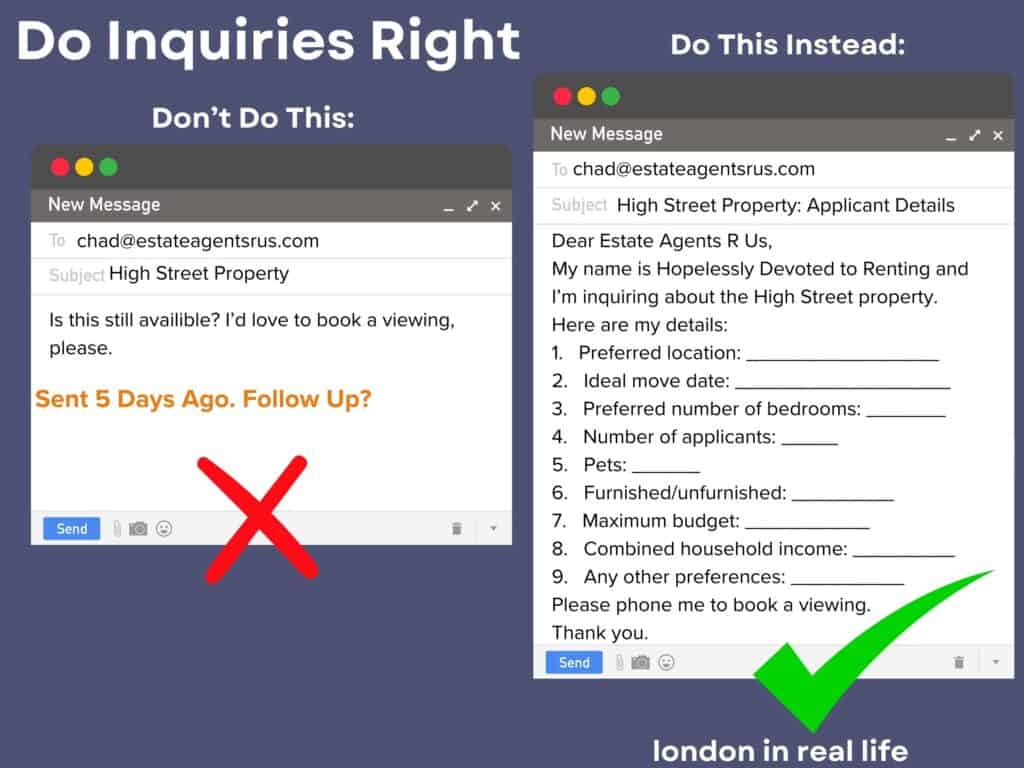
Don’t just message “is this still available?” All that will do is solicit the dreaded nonsense phone call.
Be very specific from the start. Include what you’re looking for, max budget, income, who’s renting, and what your desired start date is.
Copy and paste this list, and fill it out for each inquiry:
- Preferred location:
- Ideal move date:
- Preferred number of bedrooms:
- Number of applicants:
- Pets:
- Furnished/unfurnished:
- Maximum budget:
- Combined household income:
- Any other preferences:
This list will bypass the compulsory phone calls and back and forth, and get you into that viewing faster. You just saved half a day of phone tag with an unknown caller.
Trust me, it works, and it’s how I viewed my current property the day after it went on the market.
Tip: Set up property alerts on whatever platform you’re using. Make sure you’ve turned on notifications in the app, so the moment a property is listed you can send the above inquiry.
7. You’ll Be in a Real or Imaginary Bidding War, No Matter What
For very desirable neighborhoods and properties, there will be a real bidding war for pretty much every rental property, especially in the summer.
If it’s a property that’s been listed for a while (rare, but it happens), the agent might fool you into thinking there’s a bidding war to get more money or better terms.
If you can’t spend more (who can?), offer better terms. Offer a longer lease, no break clause, re-paint it yourself, or offer to take on some maintenance on your own.
If you own a home elsewhere in the world, like many London expats who come here for work, tell them you’re a landlord too. If you’re a handy person like me, tout what you can do, and how well you take care of your home.
Write the landlord a personal letter if you’re up against another applicant. Tell them who you are, and why they should choose you. I’ve secured two properties this way, by telling them about our family and who we are.
And if it doesn’t work, and you’re outbid, at least you tried and you did everything you could.
Tip: Get personal. (Most) landlords want to know their property is in good hands. Send them a photo of yourself, and talk yourself up.
8. Leave Plenty of Time

It’s July and you’re moving in August? You’re already too late. Flats are being listed earlier and earlier these days in this crazy market, and especially in the summer months, you’ll need to plan way ahead.
At the barest minimum, give yourself 6 weeks of hunting before you’ll need to move. 8-12 weeks is ideal, but anything less than 4, and you’ll probably have to settle for something you don’t really want.
If you start early and finish early, great! But if you start late, you’ll be stuck paying for temporary accommodation for much longer than you’d like.
Summer is the best time to move because of choice, but it’s also when the market runs faster than ever. Flats will pop up and disappear like whack-a-moles.
Tip: If you want a bit less stress, just give yourself extra time. It’s cheaper to stay in an Airbnb for a few more weeks than it is to break a lease in a depressing flat.
9. Once You’re In, Tread Carefully
Agents want to get that contract signed and that deposit paid, stat. But don’t flip through the paperwork without reading everything and understanding everything.
After your income approval and references are completed, this is when they hound you to sign, sign, sign. But now’s the time to slow down.
Make sure you understand every term, which bills you’ll need to sign up for and pay, clarify dates, and ask for anything else you need in writing. If it’s not in writing, you’re not getting it.
Tip: Keep copies of everything. They have to provide you the lease, but snap a pic of everything you sign so you always know where it is when the time comes to move out.
10. Take The Inventory Seriously
Ah, the inventory. The uniquely treacherous British tradition of making sure you still have that disgusting toilet brush that was sitting next to the loo 3 years ago.
On or right before move-in day, you’ll receive the inventory, and it will list every last bit of your flat contents. If there’s anything you want added or removed, now is your very last chance.
Is there a broken set of blinds in the closet? Ask for them to be taken away, or else you’ll have them sitting there for the length of your tenancy, taking up your valuable storage space.
Is there any damage that wasn’t repaired? Get it in writing that it needs to be fixed, or else you’re accepting the property “as is”. Check every appliance, and turn on every light switch, and check every doorknob.
If it’s not recorded as broken upon move-in, it will be recorded as broken when you move out, and you’ll have to pay for it.
Tip: Take your own videos and photos for reference, and go through the provided list and photos carefully. You don’t want to be charged for a broken toilet brush like I was (yes, seriously).
11. If All Else Fails, Move Further Out

If you’ve made it through this post without a migraine, congratulations! You’re ready for a London flat hunt.
But if you’re clenching your jaw right now, let me put your mind at ease: you don’t have to live in central London. The farther out you go, the easier, cheaper, and more relaxed the whole rental process is.
Yes, you’ll have a longer commute. But if it’s that or the constant stress of exorbitant rent, I’d choose the commute any day of the week.
Tip: Use the tube map to find areas you may not have considered before. If your office is on the Northern Line, for example, trace it north and south to find more affordable areas.
Final Thoughts for Finding Flats in London
The bottom line is that this process is fun for absolutely no one. But if you know the rules of the game, it’s a whole lot easier to play.
Good luck on your flat hunt, keep your wits about you, and when all else fails, the pub is there for a reason.
More on Renting in London
The Official Stats: The Cheapest Places to Live in London Now
Posh vs. Practical: 31 Best Areas to Live in London for You (2024)
Super Simple London Neighborhood Guide
The Average Cost of Living in London: What’s the Real Price?
First time Renting in London? The Ultimate Rental Guide
Tips for finding Short Term Rentals
Moving to London: First 3 Months Checklist