UK vs. US Education: The Ultimate Expat Family Guide
If you’re moving between the US and UK, or considering it, it’s important to understand exactly how it will impact your kids.
Sure, you’ve seen American and British schools on TV, but what are they like in real life, both as a parent and as a student?
As an American immigrant to the UK with three children, I’ve had to learn through trial and error exactly how the educational systems in each country are different, and how they’re (sometimes) similar.
Here’s my complete guide to understanding the US vs. UK educational systems, so that you can be prepared to navigate them more easily.

Please Note: In this article I use “UK” or “British” schools to refer to these collective educational systems, but these vary between each country in the UK. Systems in Wales, Northern Ireland, and Scotland may be slightly different than where I’m based in England.
Jump To:
1. Types of Schools
America has 3 general types of schools: public schools, private schools, and charter schools.
The UK has two general types of schools: state (public) schools, independent (private) schools. Within these two groups, there are several variations.
Types of Schools in America
Public Schools 🇺🇸
In America, government-funded schools are called “public” schools, and are governed by a school district. These public schools are community-based, and you’ll usually need to live within their boundaries to attend (with some exceptions).
Catchment areas and admissions work differently in different school districts, but generally, you’ll be assigned a school and don’t always get a choice.
Public schools cannot be religious in America because of the separation of church and state within the Constitution.
Private Schools 🇺🇸
Fee-paying schools in America are called “private” schools, and each have their own admissions criteria.
Only private schools in America can be religious. You don’t usually have to be a member of the church to attend the school, but sometimes it helps you gain admission if you are.
Charter Schools 🇺🇸
The third type of school is called a “charter” school, which is funded by the government, but operates independently. Each state and school have different admissions procedures for charter schools.

Types of Schools in the UK
State Schools 🇬🇧
In the UK, government-funded schools are called “state” schools. These are community-based schools that each have a catchment area in which you’ll need to live to attend.
State schools must follow the national curriculum, and they can be religious or secular. Some state schools are all-girls or all-boys.
There are several different types of state schools from which to choose from, and they all operate a little differently.
- Community schools: The most common type, these state schools are funded by the local authority and follow the national curriculum.
- Foundation Schools & Voluntary Schools: These state schools are still funded by the local authority, but have more freedom to change how they operate.
- Academies & Free Schools: These state schools are funded by the government, but have more control over their curriculum and can have selective admissions.
- Grammar Schools: These are state schools that are highly selective and provide the highest standard of education.
- State Boarding Schools: These schools still provide free education, but charge fees for boarding.
- Special Schools: State schools that specialize in educating pupils with special educational needs (SEND or SEN).
In most areas, you can apply to a set number of schools in your area (usually 6), ranking your choices. You won’t always get your first choice.
Private/Independent Schools 🇬🇧
Private schools used to be called “public” schools in the UK, but it’s a misleading term that’s no longer used.
Privately funded, fee-paying schools in the UK are called either “independent” schools or “private” schools.
These schools do not have to follow the national curriculum, but students will still have to take national exams like GCSEs and A-Levels in private school (explained further in the testing section below).
Within each are a variety of different structures, which either operate on a day school format, or a boarding school format. Many more of these schools are gendered than state schools, serving only boys or only girls.
- Pre-Prep Schools: Private primary schools for children ages 3-7 or 8 that prepare students for entry into prep schools.
- Prep Schools: Private primary schools for childrens ages 7/11 to 13 that prepare students for entry into private secondary schools. Also called “junior” school.
- Senior Schools: Private secondary schools for children ages 11/13 to 16/18.
- Boarding schools: Schools where students live on campus. The boarding model does start until age 7.
2. Age Ranges and School Structure
In America, each year of school is called a grade. But in the UK, each year or school is called exactly that: a year.
Both systems have compulsory schooling from ages 5-18, but each works a little differently.
American schools start at Kindergarten (age 5-6) and are compulsory until 12th Grade (age 18).
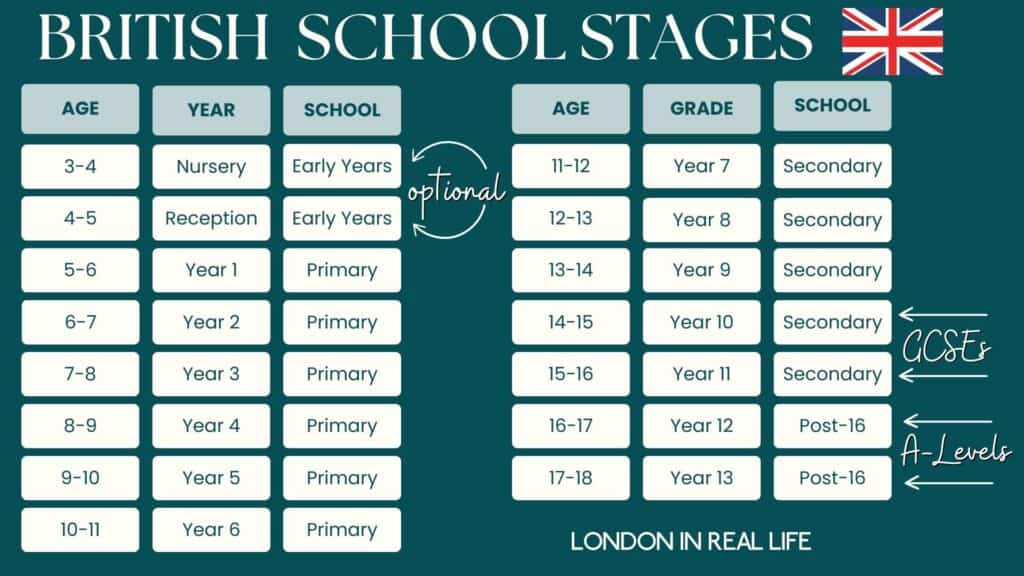
British schools start at Nursery (age 3-4) and are compulsory until to Year 11 (age 16), with various options to continue mandatory further education from ages 16-18.
US Education Grades & Ages

In the US, compulsory schooling begins at age 5 or 6 with entrance to kindergarten. Until then, parents are on their own to find and fund preschools or alternate childcare (though in some states there is government assistance with costs).
After kindergarten, a child enters 1st grade, 2nd grade, etc, all the way to 12th grade from which they will graduate at age 18.
Here’s how the different stages of school are broken down.

Elementary School: Ages 5-12 🇺🇸
Elementary schools go from Kindergarten through grade 5 or 6, depending on the school. These are usually called “K-5” or “K-6” schools.
Middle School: Ages 12-15 🇺🇸
Middle school usually consists of grades 6-8, though sometimes this stage is only grades 7-8, depending on the school. Some elementary schools are combined with middle schools, and these are called “K-8” schools.
High School: Age 15-18 🇺🇸
Grades 9-12. Grade 9 is called “freshman year,” grade 10 is called “sophomore” year, grade 11 is called “junior” year, and grade 12 is called “senior” year.
These labels are also used at university, which can make it a little confusing.
UK Education Years & Ages

In the UK, schooling years are divided up into primary school, for children ages 5-11, and secondary school, for ages 11-16.
Each year falls within a Key Stage, which is a section of the national curriculum and guides what students will learn during this time.
Early Years: Ages 3-5 🇬🇧
“Nursery” starts at age 3, and “reception” starts at age 4, and together, these make up the Early Years Foundation Framework.
Nursery is not compulsory, and is therefore not free to attend, even in state schools. But in state schools, a nursery is much cheaper than an equivalent preschool in America.
Reception is not compulsory, but it is free to attend. Most students start in reception, but some students will start their compulsory schooling in Year 1, which is akin to American kindergarten.
Nursery and reception years are included within most primary schools, though the “key stage” curriculum doesn’t start until Year 1.
Primary School: Ages 5-11 🇬🇧
Primary schools serve students from ages 5-11, and include Year 1 to Year 6, much like American elementary schools.
State primary schools follow the national curriculum for Key Stages 1 and 2.
Secondary: Ages 11-16 🇬🇧
Secondary schools serve students from ages 11-16, and include Year 7 through Year 11.
State secondary schools follow the national curriculum for Key Stages 3 and 4.
Post-Secondary: Ages 16-18 🇬🇧
After secondary school, students have several choices for how to continue their education until age 18.
Students who intend to go to university will either continue at their current school and move into the sixth form (if the school offers it), or attend a Sixth Form College. This is where students will study for A-Levels in preparation for university.
Students who don’t attend sixth form must continue in designated pathways (like a combination of work and study, or attending a trade school) until age 18.
3. Curriculum and Academic Focus
The major difference between both school systems is that the UK is an exam-based system, while the American system is not.
The UK also narrows a student’s curriculum much earlier, whilst an American student might not narrow their fields of study until university.

American Curriculum: Public 🇺🇸
The American curriculum is broad, with focus on many subjects, and includes both core subjects and elective choices.
In America, each state sets their own standard curriculum for public schools. That means that in each state, the curriculum for K-12 might look slightly different.
American public schools are not allowed to incorporate religion into their ethos or practice, but they can teach broad religious studies as long as it’s optional.
Most states use standardized testing to measure student and teacher success, though this has become controversial.
Most states offer Advanced Placement (AP) courses and programs in high school, as well as dual enrollment with community colleges for junior and senior year. Students with dual enrollment can take college courses as part of their high school curriculum, and earn college credits.
American Curriculum: Private 🇺🇸
Private schools in America do not have to adhere to state curriculum standards, and their students do not have to take standardized tests (except the SAT or ACT, for university admission, if they choose).
Each private school sets their own curriculum, and they can teach as well as practice religion if they choose.
Most private schools have a more rigorous curriculum than public schools, and include more elective choices, more sporting and creative activities, and more options for foreign languages.
UK Curriculum: State Schools 🇬🇧
State schools in the UK follow a national curriculum, which looks slightly different in England, Scotland, Wales, and Northern Ireland.
I live in London, so I’ll use the example below of England’s national curriculum, which is broken down into key stages.
- Key Stage 1 & 2 (Primary School): Focus on English, Maths, Science, History, Geography, Art, PE, Computing, and Religious Education (RE).
- Key Stage 3 & 4 (Secondary School): Core subjects (English, Maths, Science) plus optional subjects chosen at age 14 (for example: music, Geography, foreign languages, or creative arts).
- Key Stage 5 (Sixth Form): Narrower fields of study in preparation for A-Levels (subject-based exams which will determine University entrance) or BTECs.
UK Curriculum: Private Schools 🇬🇧
Private/Independent schools in the UK can set their own curriculum, though they often use the national curriculum as a guide to their teachings.
Private schools in the UK often have more choices for electives, and more offerings for studying things like music, foreign languages, and advanced subjects.
Within the private school system in the UK, students will need to take a series of exams to move from one school to the next (explained further below).
Some private schools follow the International Baccalaureate curriculum, either in all years, or at ages 16-18. This is explained further in the exam section below.
4. Exams & Grades
American grades are measured in averages in your GPA, and the SAT or ACT is the only exam that really matters for university.
In the UK, grades are measured differently in primary, secondary, and post-secondary schools, and both GCSE and A-Level scores are used for university entrance.
US Testing & Assessment 🇺🇸

In American public schools, there are several standardized tests that attempt to measure the quality of teaching and learning.
Each state has their own set of standardized tests that take place throughout a student’s education.
But overall, American standardized tests are meant to measure the schools’ performance, and not the individual student’s performance.
The only nationwide exam that most every student will need to take to advance their education is the SAT (or less commonly the ACT) in preparation for college entrance.
The SAT/ACT is taken around age 17, during junior year or grade 11 and though it’s becoming less and less necessary for college entrance, many students choose to take it.
US Grades
Grading in America is a subjective matter, and is usually done according to a standard that the school or school district has set out.
Grades per class are calculated according to how the teacher or district has laid out their curriculum. It’s usually a combination of assignments, projects, homework, and exams.
Grades are usually letter or percent based, with an A being 91-100%, B being 81-90%, etc.
Starting in middle school, students will begin receiving a GPA total.
Grade Point Average is a cumulative average of every class grade, calculated at the end of each semester. GPA uses either a 4.0 or 5.0 scale, where the highest number would represent all As.
High school GPA is taken into account by universities in their entrance requirements.
UK Testing & Assessment

The UK is a test-heavy nation. All students will take a number of important exams throughout their education that will help determine the rest of their schooling.
Primary School Tests: SATs 🇬🇧
In public primary schools, children will twice take a major standard exam: the Standard Assessment Tests, or SATs (I know, it’s confusing as America uses the same acronym).
These are standard tests that measure their learning in Key stages 1 and 2, and are taken in the spring of Year 2 (ages 6-7) and Year 6 (ages 10-11).
These exams are meant to measure student learning, but also reflect on the school and assess the effectiveness of their teaching. They do not affect a student’s progress into secondary school, but can help point out areas which the student needs more help with.
Private schools don’t have to use the SAT, but some choose to.
Secondary School Tests: GCSEs 🇬🇧
At age 16 – in year 11 – state and private school students alike will take GSCEs: the General Certificate of Secondary Education.
These are important, both for entry into sixth form programs, and for entry into the job market and universities.
Students will spend most of years 10 and 11 preparing for the GCSEs.
Subjects will take a minimum of 5 single-subject exams, including English, maths, biology, chemistry, and physics. Many students will take additional exams as well in subjects they wish to pursue in sixth form and university.
Sixth Form Tests: A-Levels, T-Levels & BTECs 🇬🇧
At age 18, students may choose to enter into a sixth form program. These final two years of undergraduate education focus on preparing them for taking A-levels.
A-level exams are subject-based exams that test a student’s knowledge of specialized subjects, and there’s over 40 to choose from. The purpose of these for most students is to get a good score and get into a great university, and students will usually take 3 A-level courses, but sometimes 4.
T-Levels are a different set of exams that are aimed at more technical and vocational qualifications. This program includes work experience and apprenticeships.
An alternative, for those who don’t want to enter university, is the BTEC: Business & Technology Education Council Diploma. This is a separate program that’s aimed at more practical skills education, ranging from art and design to trades to healthcare.
International Baccalaureate 🇬🇧
Within approved schools, students can earn their IB qualification in addition to A-Levels. If your student is considering applying to international universities outside the UK, they may wish to take these exams to help their chances of getting in.
Private School Entrance Exams 🇬🇧
Of the above exams, private/independent school students will only need to take the GCSEs and A-levels.
But within the private school system are a series of selective exams that are used to obtain entrance into independent & grammar schools.
These can be taken at a few key stages, and are called “Common Entrance” exams.
- 7+ Entrance Exam: Taken in Year 2 (ages 6-7) for children who want to enter into private school for Year 3.
- 11+ Entrance Exam: Taken in Year 6 (the final year of primary school) at ages 11-12, for children who want to enter private school for Year 7.
- 13+ Entrance Exam: Taken in Year 8 at ages 13-14 for children who want to enter into private school for Year 9.
- 16+ Entrance Exam: Taken in year 13 for entry into some sixth form colleges (less commonly required, and technically not part of the common entrance exams).
UK Grading Systems
The UK grading and assessment systems are totally different than in America, and they’re a lot more complex.
Here’s how they work.
Primary School Grades & Assessments 🇬🇧
Grades in UK primary schools are focused on age-related expectations as they are set out in the national curriculum.
In addition to the SAT at the end of key stages, students will usually be given half-termly and end of term reports. Students will be assessed in subjects and will be marked as “above expectations,” “meeting expectations,” or “below expectations.”
Secondary School Grades & Assessments 🇬🇧
In years 7-9, in addition to the assessment scale described above, schools may also adopt a numeric scale that mirrors the GCSE grading scale.
This scale uses numbers 1-9, with 1 being the lowest grade and 9 being the highest (A++).
A 7 is an A, an 8 is an A+, and a 9 is an A++. Everything above a 4 is a pass, and GCSEs are graded on a curve. That means your student is, essentially, competing with their peers for the top scores.
In Years 10-11, as students begin preparing for the GCSE exams, subject grades will be given with this scale, usually in addition to progress reports.
In these years, students will also be given target grades, which is when the teacher predicts what their GCSE score will be if they keep up with their studies. Aiming for all 9s is, of course, the goal, but anything above a 7 is considered good.
Sixth Form/A-Level Grades 🇬🇧
A-levels, the subject-specific exams taken during sixth form at ages 16-18, are graded using the letter scale A through E. A* is the highest, like an A+, and E is the lowest grade.
These letter grades are worth a certain number of UCAS points, which is the scale many universities use to determine entrance.
5. SEN in America vs. The UK
Students with special educational needs like ADHD, Autism, or developmental disorders are accommodated very differently in each country.
“SEN” services in America vary from state to state, and are accessed through collaboration with the school.
“SEND” services in the UK vary between local authorities, and are accessed through the local authority/council.
Here’s how it works (speaking as an American SEN mom who lives in the UK).

SEN Programs in America
Each state runs their SEN programs differently, and have varying levels of funding for these programs. But generally, you’ll start by speaking to your child’s teachers and school administrators.
Together, you’ll come up with a plan for how to best support your student in the classroom. These plans will be written down in an IEP (Individualized Education Plan, though different states use different terms), which all teachers and staff need to adhere to.
These plans are made in collaboration with parents, and factor in student rights, funding, medical needs, and more. In recent years, many states have done away with exclusive education, and children with SEN are included in regular education classrooms whenever possible.
If you feel your child’s needs are not being met, and collaboration with the school is not working, there are various appeals processes in place in each state.
SEND Programs in the UK
In the UK, SEN is usually known as SEND: Special Education Needs & Disabilities, though it varies from country to country.
Each local area, known as the local authority or council, lays out their process for accessing SEND services. This is called the “local offer.” This will either be a regular school that can meet your child’s needs, or in some cases, they may be assigned to a SEN (“special”) school.
Students will need to have an EHCP – Education Health Care Plan – laid out in order to access SEND services. This is a plan made in collaboration with the local authority, a child’s school, their parents, and their GP.
Remember, the government runs both healthcare and education here, so all the systems are interconnected. In many cases, your child will need to have a medical diagnosis, and the waitlists for getting a diagnosis for things like Autism and ADHD have very long waitlists in the NHS.
In my experience, it’s much more difficult to access SEND accommodations in the UK, because like everything in this country, the process is full of red tape, bureaucracy, and long wait times.
6. School Culture in America vs. the UK
School culture in America is more relaxed (except for, you know, the constant threat of gun violence).
School culture in the UK is more strict, with lots of rules and regulations for students and parents.

American School Culture
Uniforms & Dress 🇺🇸
Most public schools in America don’t have uniforms. Students can wear what they want, wear their hair and jewelry however they want, and can express their identity through how they present themselves. Most schools will have a list of banned garments, and usually don’t allow things like hats worn indoors or offensive language on shirts.
Private schools in America sometimes have uniforms, but not always.
Sports & Teams 🇺🇸
Sporting is big in both countries in schools, though America usually has school-based teams. Football, basketball, baseball, volleyball, swimming, cheerleading, and many more are offered at most larger schools, and practice usually takes place either before or after school hours.
Sporting events and games are opportunities for the community to come together, and are often looked forward to as important social events for students, teachers, and parents.
School spirit is often channeled through these sporting events, and students often take pride in their school and their teams.
Extracurriculars 🇺🇸
In America there are generally more opportunities for extracurriculars, either through school clubs or through electives. Debate teams, student government, yearbook, math and science clubs, and many more are usually offered in addition to a student’s core curriculum.
Discipline 🇺🇸
Discipline varies from school to school, and it’s generally at the teacher or principal’s discretion. Detention is still used as punishment for things like foul language or use of cellphones in class. Students can be suspended for periods of time, or expelled for continuous behavior issues.
School Breaks 🇺🇸
Schools usually run on a semester system in America, with two semesters per year. School breaks in America are fewer, with a longer summer break. Most school districts require 180 days per school year.
School usually starts in September, has a mid-winter break of 1 week, a winter break of 2 weeks, a spring break of 1 week, and a summer break of at least 2 months.
When these breaks take place vary between school districts, with some schools starting in August and ending in May, and some schools starting in September and ending in June.
Attendance 🇺🇸
Attendance requirements vary from state to state and school to school, but in general, students and parents are not reprimanded for a child’s attendance record unless they are truant (chronically absent).
Gun Violence 🇺🇸
Though American students might have more freedoms, they also have a lot less. There’s the constant threat of violence in the classroom. Schools often run active shooter drills (yes, that’s real, and not only something you see in TV shows), and schools are often equipped with metal detectors and police or security officers.
As a parent, this is one of the major reasons I chose to raise my kids in the UK. I know that when I send my kids to school, they will come home afterwards.
British School Culture
Gendered Schools 🇬🇧
It’s much more common to find gendered schools in the UK vs. America, and some of the most prestigious schools are for only girls or only boys.
Uniforms 🇬🇧
It’s very rare that a UK school – either public or private – will not require uniforms. This usually consists of a formal uniform that includes a blazer, as well as a sporting uniform. Requirements vary from school to school, as does the strictness & enforcement of the uniform policy.
Uniform policies usually include restrictions on hair color and style (natural colors only), and do not allow wearing of jewelry, nail polish, or too much makeup.
Sports & Teams 🇬🇧
Sports is usually something that students in the UK do during the school day as part of the core curriculum, and not on teams after school (though some schools – mostly private – do have sporting teams).
Extracurriculars 🇬🇧
UK schools often do have a variety of clubs to join, from chess to debate to community service. These clubs usually take place during lunch or after school.
School Breaks 🇬🇧
School breaks come more often in the UK, with a shorter summer break than in America. 190 days of school are generally required in a year.
Schools in the UK run on a term system:
- Fall Term: September to December
- Spring Term: January to April
- Summer Term: April to July
In the middle of terms, there are half-term holidays, usually 1 week long. At the end of term, there are term breaks that are usually 2 weeks long.
Summer is usually 6 weeks long, beginning in the end of July and with school resuming in the beginning of September.
There are also lots of bank holidays, where students will have mondays off at various points throughout the year.
Most state schools run along the same schedules for breaks, while private schools may have slightly different weeks off.
Attendance 🇬🇧
The UK has very strict attendance policies in state schools. Parents are legally required to ensure their student attends school.
Students must attend daily unless they are sick, or have been given permission for an appointment or interview. In many cases, schools will require a doctor’s note for prolonged illnesses. Going on holiday is not an authorized reason for absence.
If your student misses more than 5 days for unauthorized reasons, the local authority can and will fine the parents, or in some cases take legal action.
Yes, that means you can be fined and taken to court for your child’s absences. This system is a nightmare for parents of SEND students (like me) who may have difficulty attending school regularly, and schools do not offer the option for students to attend virtually.
This attendance regulation only applies to state schools, and private schools each have their own attendance policies which are strict, but a bit more flexible.
Discipline 🇬🇧
Behavior policies in the UK are generally much more strict. Each school has their own system, usually consisting of demerits and sanctions. This includes punishments for not following uniform codes.
Students can get a verbal warning, a letter home, removal from the classroom, or detention. Exclusions from school do happen for repeated behavior violations.
Some schools are more strict than others.
7. Costs of Education
Both countries have comprehensive public school systems that are free to attend. But if you’re considering a private education, it’s important to consider the costs.

Cost of a Private American K-12 Education
In 2024, the average cost of a private K-12 annual tuition was $12,350 (£10,149). But in my experience, that’s on the low end, and it varies from state to state.
In New York, for example, you’ll pay an average of $11,530 (£9,475) for a private elementary school, and $22,510 (£18,498) for private middle and high schools. Some of the most prestigious private schools, however, can run upwards of $65,000 (£53,416) per year.
In more rural states and in smaller cities, these fees will run closer to the average.
You’ll also have to factor in costs of transportation (not usually provided in private schools), supplies, uniforms, lunch, extracurriculars, sports, and school trips.
Cost of a Private British Education
The fees for a private education in Britain just went up, by a lot. Parliament removed the tax exemption for private school fees, and they’re now taxed at a whopping 20%.
The average lies at £18,063 ($21,979) for day schools, and £36,000 ($43,806) for boarding schools. These fees vary between schools and locations, and don’t include the recent 20% tax.
Where I live in London, you can expect to pay about £15,000 ($18,253) per year for private primary school, and £25,000 ($30,421) for private secondary school.
Some of the most prestigious private boarding schools can run upwards of £40,000 ($48,674) per year.
You’ll also have to factor in the new 20% tax, supplies, uniforms, clubs and sporting, school trips, and lunch fees (if lunch is charged separately).
8. Pros and Cons for Families Moving
If you’re trying to figure out how your child will be affected by moving countries, here’s what we have experienced as pros and cons, from firsthand experience.

Pros of American Schools ✅
- Friendlier, with more opportunities for social activities (for students and parents alike)
- Less strict overall, and more understanding of SEN needs, attendance issues, and emotional difficulties
- Freedom of self expression through clothing, hair, and jewelry
- More opportunities for advanced learning (AP courses, dual enrollment)
Cons of American Schools ❌
- The threat of gun violence
- Less rigorous curriculum
- Few early years education opportunities
- Curriculum varies from state to state & is not always politically neutral
Pros of British Schools ✅
- No threat of gun violence
- Rigorous academic curriculum
- More opportunities for early years education, from age 3
- Huge variety of private schools to choose from
Cons of British Schools ❌
- Strict rules, lots of red tape, and long, bureaucratic processes
- Test-based curriculum, and “teaching to the test”
- Limited self-expression (hair color, jewelry, etc)
- Punitive attendance policies
- Specialized subjects from age 14-15, when students might not know what they want to study yet.
Is Education Better in America or the UK?
Education in these two countries is so vastly different that it’s hard to compare them side by side. Neither one is “better,” and I wish that I could take parts of both systems and combine them into one, making the ideal educational atmosphere.
But if you’re moving – either by choice or for work – it’s so important to do your research, and know exactly what you’re getting into.
Remember, it won’t all come easily or naturally at first, for you or for your kids. You’re learning a new nation’s systems for the first time, and it will all feel foreign and strange.
My best advice is to just be there for kids, and help them navigate this new world of school as best you can. Try to learn exactly how each system operates so you can be the best advocate for them that you can be.
It’ll be scary at first, and that’s okay – that feeling will slowly pass, and you’ll get used to your new normal. And when you miss your home country, try to remember all the reasons you moved in the first place, take a deep breath, and take it one moment at a time.
Read More About Moving to the UK:
Types Of Visas Available For Living And Working In the UK
How Much it Costs to Move to the UK
How To Set Up Your New Life In The UK
Private Healthcare Options For Expats
Read More US vs UK Comparisons:
How Your Life Will Change Moving to the UK from the US
Ultimate Smackdown: UK vs US: Which is Better?