
Where’s Better for Raising Children: America or the UK?
If you’re a parent considering a move between America and the UK, one of the most important factors is how it will affect your kids. Will it make your life easier as a parent, and their lives easier as children?
As an American who chooses to raise her 3 kids in the UK, I know firsthand all the differences between parenting in these two countries. But is one really better than the other?
How will your life, and your children’s lives, change? What challenges will you face, and will you always think the grass is greener elsewhere?
Here’s my complete comparison between raising kids in America vs. the UK. I’ll include everything from healthcare to schools to friendships and cost of living, so that you can make the most informed decisions about your children’s futures.
Table of Contents
1. Education Systems
You can get a great education in either country, but it might look very different than what you’re used to.
Don’t know anything about American or British school systems? Read my complete breakdown of American vs UK education systems here.
Education in America
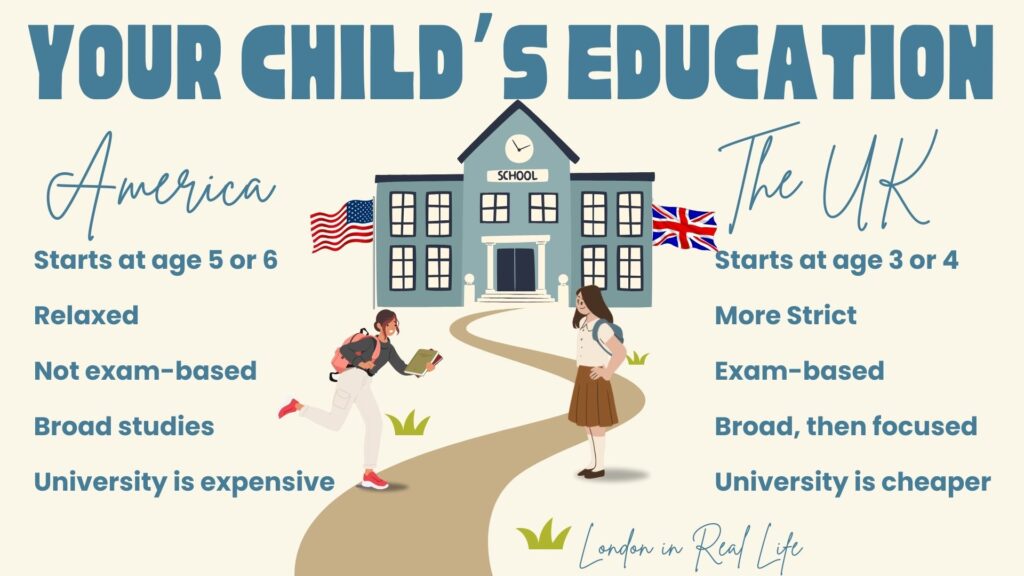
Education in America is a much more relaxed atmosphere, but the quality of education really depends on where you live. Private schools are more rigorous, but can be costly.
Standardized tests in most states are used to assess the quality of education, and not to reflect on the progress of individual students.
The American curriculum is broad from kindergarten all the way through 12th grade, and students won’t begin to specialize in their chosen subjects until university.
Still, there’s a huge variety of electives, extracurriculars, sports, and social events in most American schools.
University costs vary between in-state public universities (average $11,260 per year), and private universities (average $35,248 per year).
The major drawback of education in America is that it comes with the constant threat of gun violence. There were 971 school shootings in America in 2024 alone, in elementary, middle, high schools, and colleges.
Education in the UK
Education in the UK is a more strict affair, with a standard curriculum and testing across the board. Public (state) schools use the national curriculum, and private schools provide a more rigorous take on the national curriculum.
If you want your student to go to private school, they’ll usually need to take exams to get in.
The UK is a test-heavy nation in every setting.
Beginning in primary school, state school students will take SATs (Standardized Assessment Tests).
In secondary school, both public and private school students will study for and undertake GCSEs. GCSE scores help determine where a student can study for A-Levels, yet another massive exam, and A-level scores help determine where they can go to university.
Throughout these important national exams, students begin to narrow their field of study, and will need to know what subjects they want to pursue in university before they enter.
Still, there are extracurriculars, electives, sports, and social events, but not to the extent that there is in America.
Attending university is much cheaper in the UK, and though you’ll need to go through GCSEs and A-Levels to get there, you’ll be rewarded with an average cost of only £9,250 per year ($11,389) across the board (yes, even at ultra-prestigious universities like Oxford and Cambridge).
There is the threat of knife violence in British schools, especially in some urban public schools, but nowhere near reaching the level of threat that American students undergo.
Read my complete guide for how to choose and apply to UK schools here.
2. Healthcare
Healthcare in America is faster but expensive, and healthcare in the UK is slower but cheap. As a parent, both systems can be equally frustrating.

Healthcare in America
Healthcare in America is notoriously expensive. If you have great health insurance sponsored by your company (but still partially paid for out of your paycheck, as it always is), it won’t seem like that big of a deal.
With very good health insurance, you can expect to pay a $10-$25 copay for doctor’s visits and prescriptions. With limited or cheap health insurance, that copay can look more like $40-55.
But if you have limited coverage, you can expect to pay $750-$1500 for a trip to the emergency room with your child (and that’s not including any tests or x-rays). If you have no coverage, the cost can exceed $3,000. That’s enough to send most American families into debt they can’t recover from.
Even with great coverage, the insurance system likes to surprise you. You might get a random bill in the mail for diagnostics you had months ago – that were supposed to be covered – for $400.
Still, healthcare in America can be wonderful if you can disregard the costs. Doctors are generally thorough, specialists can be seen easily, pediatricians are accessible and caring, and hospitals are generally well run and efficient. Getting care for your child is much faster and more efficient.
Healthcare in the UK
Every UK resident is provided healthcare through the NHS (National Health Service), but contrary to public opinion, it’s not free. We pay for it through our taxes, national insurance contributions, and the healthcare surcharge with your Visa application fees (up to several thousand pounds per applicant).
Accessing healthcare within the NHS is much more complicated than in America, and wait times are much longer. Everything is coordinated through your GP, who is your general practitioner (even for babies and children), and your gatekeeper to healthcare.
You’ll need a GP referral to access basically anything, and once you get that referral, be prepared to wait a long time for specialist services, especially for children’s mental health and developmental differences (like autism and ADHD).
But the UK also has a robust private healthcare system that’s pay-as-you-go. If NHS wait times are long, you can pay to see a private specialist right away. Even private doctor fees are much, much lower than American health care costs.
Private insurance is generally affordable, and some larger companies will provide it so you can see private doctors easily.
One of the other major differences is that the NHS doesn’t perform nearly as many health checkups for kids, or for adults, as American doctors do. There’s a national schedule for routine care, so unless your child is sick, you won’t be making constant trips to the doctor’s office.
Routine services like eye tests and vaccines often take place in your child’s school, which makes life a lot easier on parents.
3. Wages, Work/Life Balance & Parental Leave
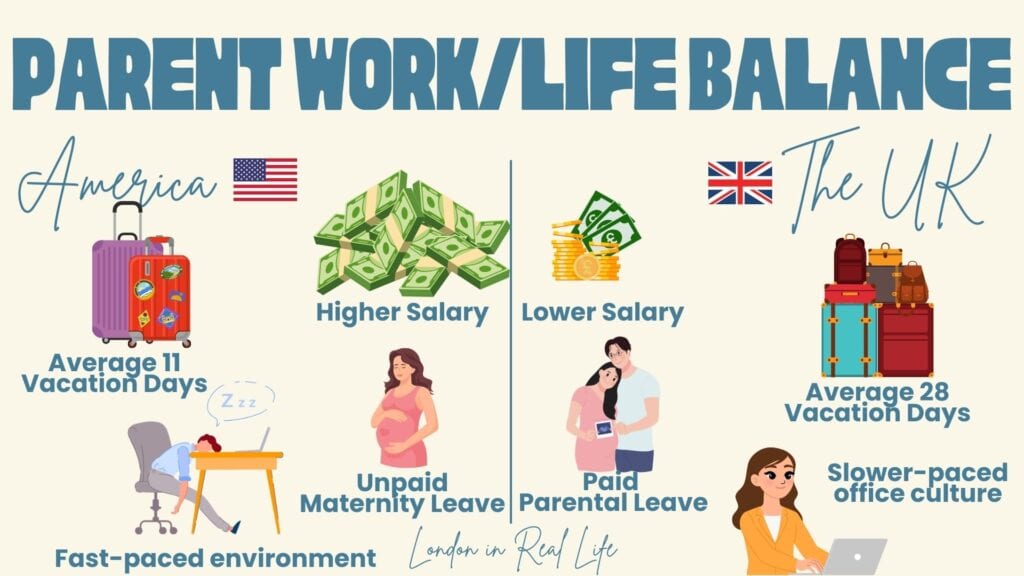
America has higher wages, but short, unpaid parental leave and longer working hours. The UK has lower wages, but statutory parental leave and holidays.
American Work Culture & Time Off
American wages are generally much higher than in the UK. A software engineer, for example, can earn upwards of $130,000 in the US (£105,673), while the average in the UK is £70,000 ($86,114).
However, America has no national requirements for paid time off or parental leave. Instead, each company creates their own PTO policies.
The average American worker gets 11 paid vacation days per year. If you’ve just had or adopted a baby, you’re entitled to 12 unpaid weeks off. Individual companies may offer more generous policies, but they don’t have to.
Culturally, American companies push employees to work harder and longer hours: productivity is the name of the game. Whether your company fosters any work/life balance is simply up to the company and your superiors.
If your child gets sick and you have to stay home with them, you might have to take an unpaid vacation day. If you run out of time off, you risk getting fired. As a parent, this is terrifying. Do you work, or take care of your child? You can’t always do both.
Culturally, American offices are generally friendly, with open and direct communication, which might be a struggle for the more reserved British worker.
British Work Culture & Time Off
British wages are generally lower than in America. A software engineer, for example, earns an average of £70,000 in the UK ($86,114), while an American in the same job earns an average of £105,673 ($130,000).
But the perks of working in the UK include lots of annual leave and paid leave. Most UK employees are entitled to 5.6 weeks (28 days) of annual paid leave.
Mothers are entitled to 52 weeks of maternity leave, 39 weeks of which is usually paid. Parents can also share that leave with their partners with shared parental leave.
The UK also offers paid leave for things like bereavement, caring for a relative, jury duty, and more.
There are also several bank holidays per year, which give you a nice 3-day weekend.
Culturally, working in the UK is a bit more relaxed, and employers are more understanding of time off for things like doctor’s appointments and caring for a sick child.
Many parents will take time off on term breaks or half-term breaks to go on holiday. Most workers will also take time off in August, and offices during this month are fairly empty. The same goes for the week between Christmas and New Year’s Day.
One thing to be aware of, however, is that Americans can have trouble acclimating to the office culture in the UK. While Americans are open in discussing ideas and plans, communication can be a bit more cryptic and culturally-coded here.
Office workers can be a bit cliquey, too, and aren’t always keen to accept newbies into their social groups. You’ll get more time off, but you might not be super happy at your job.
4. Cost of Living
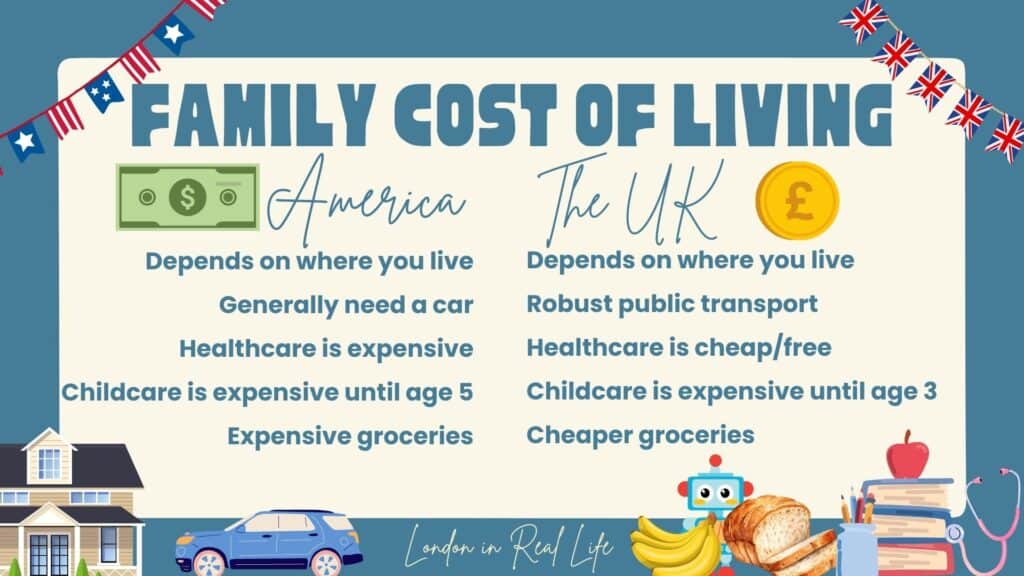
The cost of living is skyrocketing in both countries, but it really depends on where you live in each nation.
American Cost of Living
America is huge, with the cost of housing varying dramatically between major cities and rural areas.
You can rent a 2-bedroom apartment in New York City for an average of $5,500, where you’ll have plentiful employment opportunities. But you can rent a 2-bedroom in rural California for a mere $1,500, where you’ll have far less job opportunities.
Living in rural America is generally more affordable. But you’ll also have to factor in the cost of a vehicle and gas, commute times, school district quality, and traveling for basic needs like groceries and healthcare.
Healthcare is another major expense no matter where you live. If it’s not sponsored by your employer, you can expect to pay an average of $25,000 per year for a family policy. If it is sponsored (partially paid for) by your employer, that cost goes down to a few hundred dollars per month.
You’ll need a vehicle living in most places in America, and pay for gas, maintenance, licensing and taxes. Groceries are expensive, and the prices will only go up in the near future.
Keep in mind that social safety nets are less common in America, and government assistance with things like housing, food, education, and healthcare are minimal. This is particularly scary when raising a family, as there’s not much to catch you if you get a surprise medical bill or your car breaks down.
UK Cost of Living
The cost of housing varies dramatically throughout the UK. You can rent a 2-bedroom in London for £3,000 ($3,600), where you’ll have lots of job opportunities, or a 2-bedroom in the West Midlands for £1,021 ($1,255), where you’ll have fewer opportunities and need to own a car.
Though wages are lower in the UK, many things are covered by the government that aren’t in America. If you’re a citizen and run into hard times, there are robust social safety nets for housing.
Your healthcare will be mostly free, though for immigrants, we usually pay for it up front with the healthcare surcharge attached to our Visa fees.
The UK has robust public transportation, especially in major cities. If you live in a large city like London, you probably don’t need to own a car.
Grocery prices are, on the whole, much cheaper in the UK than in America, but things like clothing and basic necessities are about the same price.
Childcare costs are similar to America, but keep in mind that school begins at age 3 rather than age 5. That’s two less years you’d need to pay for childcare. Most primary schools also offer affordable after school childcare.
Travel is generally much cheaper within Europe than it is in America, which is one of the major advantages of living across the pond. You can take your kids to Spain for half-term without worrying about running out of vacation days.
5. Community and Safety
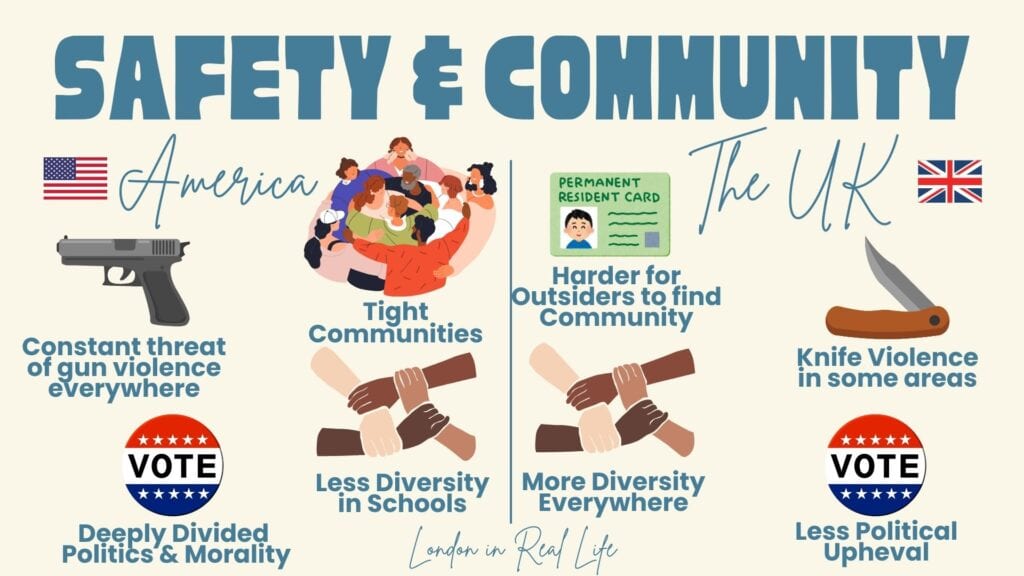
Living in America comes with the constant threat of gun violence, but communities are tighter knit and more welcoming.
Though there is knife violence in the UK, generally it’s much safer, though finding community – especially in large cities – can be a challenge.
Community and Safety in America
Americans band together and form tight communities. Neighbors help neighbors, and parents help parents. It’s easy to make friends and find your people.
Most places in America are diverse, but many areas are still very white. If you live in an expensive community, chances are your child’s school will be majority white and Asian. This isn’t great if you want your child to grow up in a truly diverse environment.
Politically and morally, America is split in half. Half of us believe in equity and inclusion, welcome diversity and immigration, support any gender identity and sexual orientation, believe in a woman’s right to choose, and want to ban guns.
The other half, however, are racist, bigoted, sexist, misogynistic, and ignorant. This is very scary as a parent, because we see the world our children will inherit, and it’s not a good one. The war happening inside America is not political, it’s moral, drawn down party lines.
But the biggest drawback of parenting in America is, of course, violence. As Americans, we live under the constant threat of mass shootings. Gun ownership is so unregulated in most areas that civilians can own assault weapons usually only used in war zones.
Every phone call from the school comes with a moment of terror: is it happening? Is my child okay? Most of us have to live under the delusion that it won’t happen in our school just to keep our brains from melting down.
Yes, it’s a terrifying way to live. Yes, it’s one of the major reasons I choose to raise my children in the UK, because at the end of the school day, I’d very much like them to come home alive.
Community and Safety in the UK
People in the UK are a bit more insular, especially in larger cities. It’s harder to make friends and find your community as an immigrant, and most expats end up befriending other expats from their country.
In more rural areas and smaller towns, communities can be a bit more welcoming and supportive. But some very small villages are wary of newcomers.
As a parent, your child’s school community might not be the built-in social network it was in America. There are less school and community events in which to socialize with other parents, and this is especially true in large cities. Private schools generally foster tighter communities of parents.
There is knife violence in the UK, mostly in parts of large metropolitan areas. But ownership of knives is tightly regulated and punishable by significant time in prison, unlike the gun laws of America.
Politically, the UK isn’t as starkly divided as America. Yes, there is still racism and xenophobia nationwide, with some areas leaning heavily tory and some leaning heavily labour. But as a whole, the UK is much more diverse than America, especially in large cities, both politically and culturally.
6. Cultural Norms and Values
America is fast-paced with a huge emphasis on work and money. The UK is a bit slower, with more emphasis on enjoying life.
Cultural Norms and Values in America
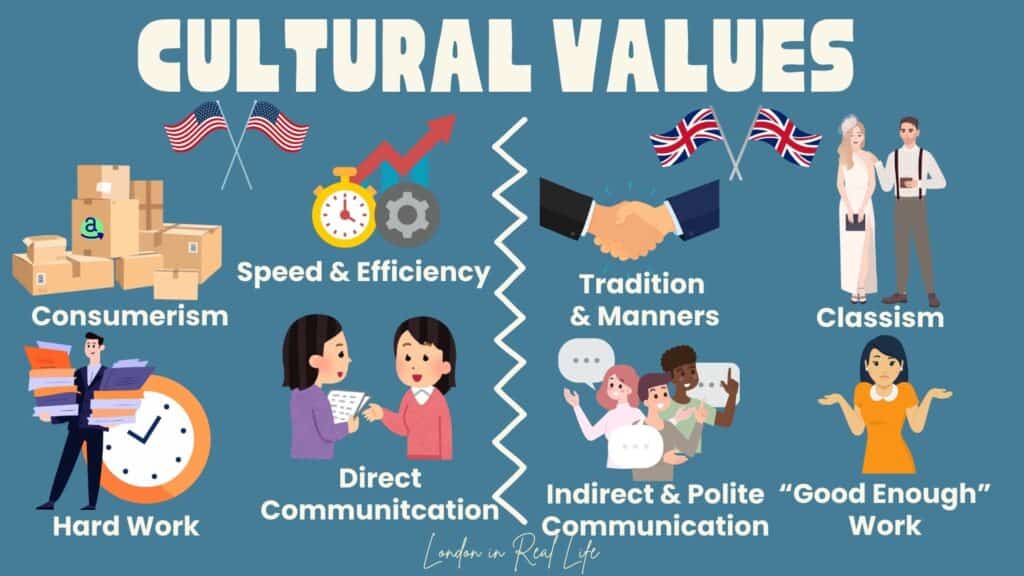
America is focused on individual success, or attaining “the American dream”: a big house, 2.5 kids and a dog. It’s ingrained in us from childhood that if we work hard, we’ll be rewarded with financial success.
It is, of course, a lie. But we still want it, and go after it with gusto. Our consumerism is unmatched, and our success in America is displayed by what we have (a huge house, the latest color Stanley Cup, a blingy engagement ring).
We are always striving to do better and innovate. We try to go faster, do things in a more efficient way, and get it right the first time. As a parent, this makes life easier. We get help and answers for our kids quickly, from doctor’s appointments to meetings with teachers.
In communication, Americans are blunt and to the point. We don’t dance around the issues; we say what we want. This can be jarring for a British person, who is more focused on civility and tradition.
Cultural Norms and Values in the UK
British culture is more focused on manners, and has deeply encoded classism. Who you are is defined by your accent, where you went to school, and where you work.
There’s a strong emphasis on tradition: things are done a certain way because they’ve always been done a certain way. There’s no ambition to make things easier, or better, or more streamlined, because if it’s “good enough,” it’s good enough.
In communication, Brits speak in code, and it’s a code that’s very hard for foreigners to crack. Their words are deeply encoded in civility, and what they say is not what they mean.
This can be frustrating for Americans who just want a straight answer. It’s also incredibly frustrating when the pace of daily life – like booking an appointment, or trying to find out important information – is very slow. It might take a week of emails back and forth to get what you need, when in America, all it would take is one.
Processes – from applying to schools to getting medical care for your kid – are full of bureaucracy and red tape. Why? Because they’ve always been done that way. This can be really frustrating as a parent when you’re just trying to get help for your child, and it’s taking ages upon ages.
Socially, everything takes place at the pub. But it’s not to get drunk (though many do), it’s to catch up with your friends and neighbors. Most Brits have a “local,” where they’ll pop in after work and on the weekends to catch up on the local goings on.
7. Social Lives for Parents & Children
Americans are more open, friendly people, and it’s generally easier to make friends and create a support system in the US. Parents and children tend to be more reserved and harder to get to know in the UK, especially as a foreigner.
Social Lives in America
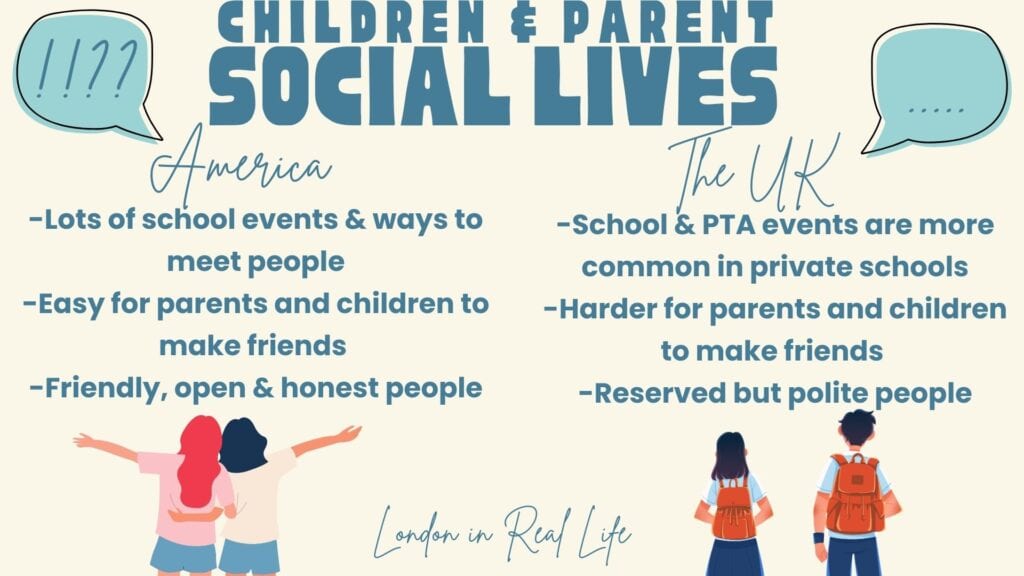
Americans are notoriously chatty, open, and honest. Strangers talk to strangers, which is a big benefit if you’re new to America. People are generally curious, like to find out all about you, and it’s easy to make friends even if you’re an introvert.
Making parent friends is especially easy, and elementary schools are a built-in social network for parents. There are PTA events, sporting events, parents nights out, fundraisers, musicals, concerts, and many more opportunities to meet other parents.
American children are equally easy to befriend. Children tend to make friends quickly both in and out of school, and playdates are a very common way for younger kids to connect. You’ll host your child’s friend, or your child will go to a friend’s house after school.
Both American parents and children say what they mean, which can be taken as blunt or rude to some other cultures. But it’s just how we are; we don’t beat around the bush. If we like you and want to be friends, we’ll ask you for a coffee or a drink.
Social Lives in the UK
Brits are notoriously polite but reserved. Especially in large cities like London, strangers don’t talk to strangers. If they do, it’s idle chit-chat about the weather or the football game. This can make it very difficult to befriend the Brits as an American: we seem too forward or rude for their liking.
Making parent friends can be tricky if your child goes to a state school in a large city. There are not nearly as many events where parents can get to know one another. In private schools, you’ll have better luck meeting and befriending other parents as there are more school and PTA-sponsored events.
British children, I’ve found, can be a bit more cliquey than American children, and it can be a bit harder for your child to break into friend groups. Play dates are much less common, especially in London, where our homes are not necessarily big enough to host.
In large cities like London, it’s more common for older kids to roam about after school, or hop on the tube or bus somewhere. Teens have more freedom in the UK in this way, because their transportation isn’t solely reliant on cars.
The Brits are a cryptic bunch, and can be especially hard for Americans to crack with our relentless positivity. You may need to have five conversations about the weather before you reach a topic that has any weight, and even then, you might not make it to the phone number exchange for weeks or months of seeing each other daily at school pickup.
This is not true, however, in smaller and more rural communities in the UK. Those locales can be a bit more friendly in general, though it’s still hard to break into friend groups as a foreigner.
8. Opportunities for Children
We all want the best for our children. But which country really offers the best for them?
Opportunities for Children in America
In America, the quality of your child’s education depends on where you live. Since each state creates their own curriculum, there are disparities in the quality and breadth of education nationwide.
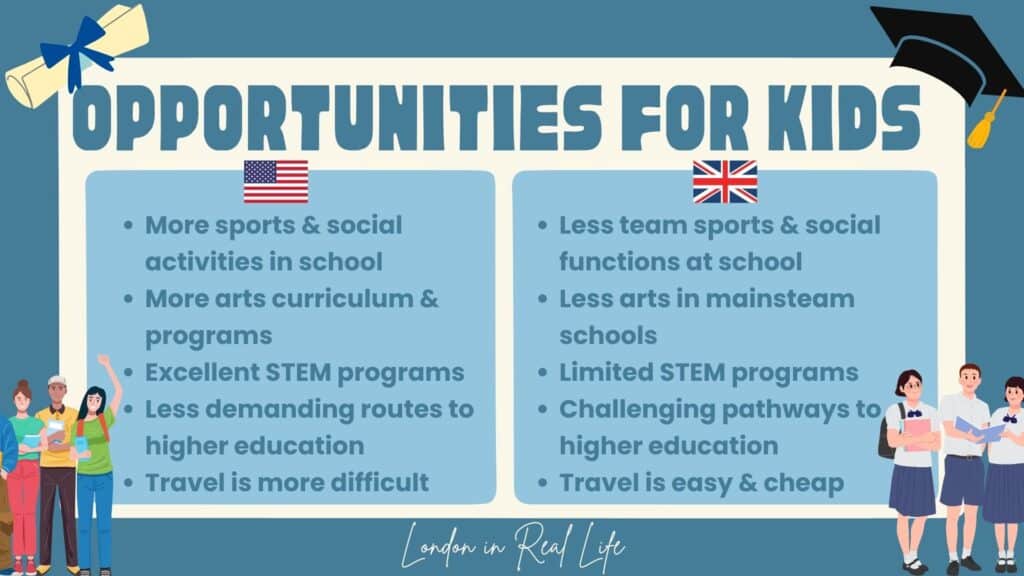
Both inside and outside of school, there are many opportunities for sports, and team sports are a key part of many children’s lives. Football, baseball and basketball are the major ones, but many schools also offer teams for volleyball, cheerleading, softball, swimming, track & field, and more.
Arts are also integrated into American schools more widely than in the UK. Drama, painting, ceramics, dance and music are usually offered in most public and private schools. There are also specialized high schools for the arts in many areas.
America generally offers more extracurriculars, from robotics to debate to the school newspaper. After school clubs are popular, and most schools have a wide array to choose from.
STEM programs in American schools and universities are unmatched, and encourage innovation and interest in science and technology from a young age. America also has some of the best STEM universities in the world.
Accessing higher education depends on a student’s grades, extracurriculars, SAT scores, admissions essays, and other various factors. Private universities and prestigious state schools are highly competitive, and you’ll have to apply to multiple different schools to get a chance at any one of them.
Culturally, Americans don’t get to travel as much as Europeans because of the prohibitive cost. If you want your student to experience the world, it’s much easier and cheaper to do it living outside of America.
But overall, America is focused on individual success. The privileged get access to the most opportunities, and a lot of it is based on who you know and how much money you have.
Opportunities for Children in the UK
The UK’s National Curriculum means that your child will get a robust education no matter where you live. Of course the overall quality of schools varies, but each student will be given the same basic education and opportunities in state schools.
There is far less sporting and physical education in schools. Team sports are usually reserved for private schools or teams outside of school, and these are usually football (soccer), rugby, cricket, and tennis.
Extracurriculars are more widely available in private schools, and are usually focused on hobbies, sports, and academic achievement.
STEM programs are growing more prominent in British education, but are not as robust as American programs. If a student wants to study in a STEM field, they’ll have to take the related GCSE and A-Level exams in their teen years (computer science, maths & further maths, physics, et al).
Getting into university depends on these test scores, and university admission is highly competitive, especially at the top schools. UK students narrow their fields of study much earlier than American students, and will have chosen their degree pathway before applying to university.
University is still expensive in the UK, but not nearly as much as the top American schools. And if your student doesn’t want to attend university, there are robust vocational pathways, including apprenticeships and trade degree programs.
Culturally, it’s much easier to travel to other countries and be exposed to different ways of life when you live in Europe. Children in the UK have more opportunities to broaden their cultural horizons, and there are often class trips abroad.
Like America, the UK is also focused on individual success, and the privileged get the most opportunities. There is a more strict class structure in place, and social mobility is difficult.
There’s also immense pressure to get good GCSE and A-Level scores, because it will dictate your university, which will dictate your career opportunities. It’s a lot of stress to put on teenagers, and this exam-heavy system is not one size fits all.
Where Should You Raise Your Kids?
There’s no one single answer for any family; both the US and the UK have their pros and cons. There are things about America that I vastly prefer as a parent, and things that I equally prefer about the UK.
Since there is no easy answer, I encourage you to weigh the importance of each factor. Gun violence, for instance, weighs more than the ease of making friends, and affordable healthcare might weigh more than vacation days.
What really matters to you? What kind of environment do you want your children to grow up in? What matters the most to your child, and what do they think of the big move?
Moving abroad is not easy, and it will take a lot of getting used to wherever you go. But once you get there and get settled, what kind of life will your kids really have? If you answered “better,” for any reason, there’s your answer.
Read More
How to Find & Apply to UK Schools
How Much it Costs to Move to the UK
Private Healthcare Options For Expats
Living in the UK vs US: Ultimate Smackdown Comparison
How Your Life Will Change When You Move to the UK
Here’s What Europeans Really Think of Americans


