How Big is London? What Tourists Need to Know
Tourists ask me everyday, “How big is London, really?” They want to know where they should stay, how to get around, and how many days to spend here.
The answer is: London is way bigger than you think.
You should stay closer to the center than you think, you’ll need more time here than you think, and you should plan more time for transport than you think.
The biggest mistake tourists make when visiting London is underestimating the size. And before you actually arrive and begin exploring, it’s hard to understand just how massive this city really is.
Here’s my easy guide to understanding the size of London, including some important London geography, tips for getting around London, and size comparisons with other major cities.

Jump to:
London Geography
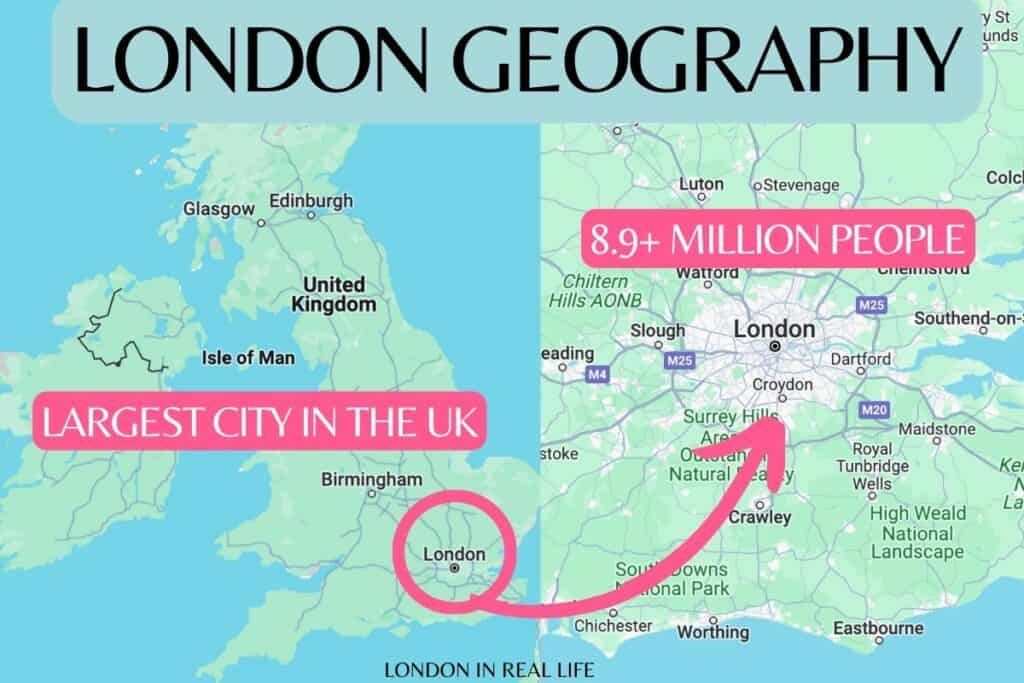
London is the capital city of the United Kingdom and the largest city within England, Wales, Northern Ireland, and Scotland.
Current population estimates that over 8.9 million people live in the Greater London area.
Understanding the Size of London
London is separated into two areas: Greater London and Central London.
Greater London is massive, while Central London is more manageable.
You might also have heard of the “City of London”, which is the historic centre of London and falls within Central London (yes, it’s two cities in one!).
Greater London & London Airports
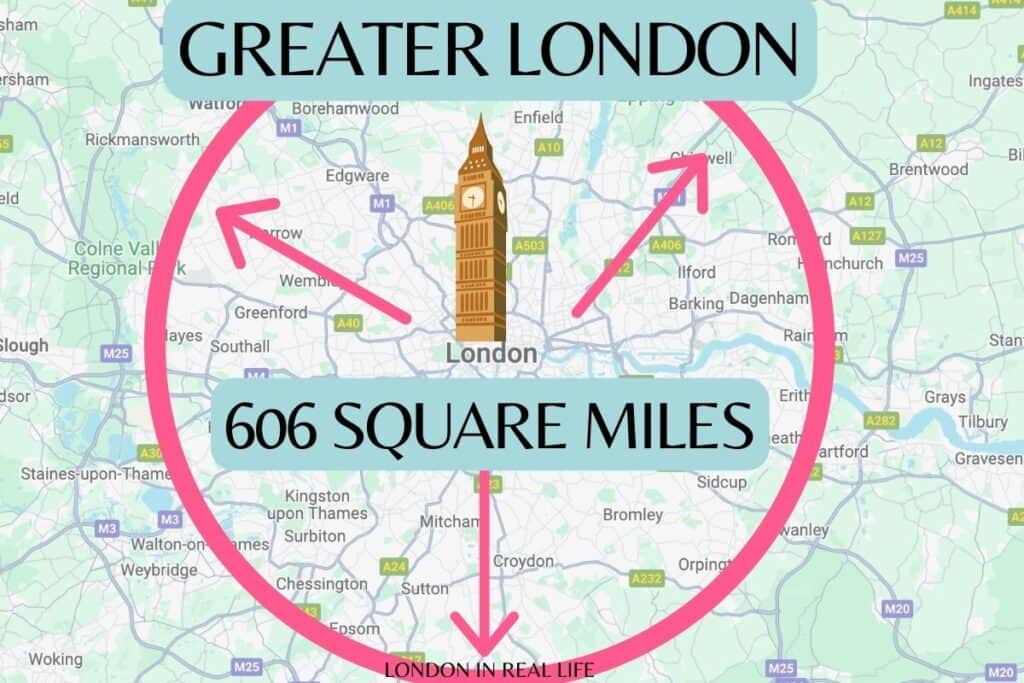
Greater London covers a whopping 606+ square miles.
West to east, it’s about 36 miles across. That’s more than 4 times the width of Paris.
North to South, it’s about 25 miles. That’s about twice as long as the island of Manhattan in New York City.
But as a tourist, you don’t need to worry about the massive area of Greater London. Where you’ll most likely be is Central London, where most of the sightseeing is.
You’ll usually only visit Greater London if you fly into most London airports.

Two major airports in London that most (but not all) visitors fly into are Heathrow Airport and Gatwick Airport. These are both in Greater London.
Both these airports are roughly an hour outside the city by train, or longer in a car.
See my complete guide for getting into London from all airports here.
London Geography: Central London

Central London covers the areas closest to the center of London, or what some Americans would call “downtown London.”
Though there is no single “downtown” or “central” area of London (there are many), the Central London area is where most tourists will want to stay.
This area is only about 5 miles across (depending on where you measure from), and is very easy to navigate by tube, bus, and walking.
Central London contains most of the major tourist attractions, and includes the major neighborhoods of:
- Westminster (Big Ben, Buckingham Palace, etc.)
- Covent Garden (West End Theatres)
- The City of London (the historic center)
- Marylebone & Mayfair (Oxford Street shopping)
- And many more.
Getting Around London: How Long it Takes
Let’s look over some example routes to see how long it will take you to get around London.
See my complete map of London tourist attractions and how to use mapping apps in London here.
Tube Example Route

Getting from Buckingham Palace to the Tower of London is easy on the tube.
If you take the Circle Line, it will take you about 30 minutes.
The total distance is about 3.5 miles.
Keep in mind that anytime you take the tube, the ride itself may be short, but the walking distances on either end of your journey may take some time.
See my easy, illustrated guide for using the London Underground here.
Bus Example Route

To get to Borough Market from the London Eye is an easy 12 minute bus ride.
Bus rides are great for those shorter journeys, or when the tube is too far away or inconvenient.
Buses are also great for sightseeing if you can snag a seat on the upper deck!
See my full guide for how to use London buses here.
Train Example Route

If you want to go somewhere outside the city – like Hampton Court Palace – you’ll need to take the train. This destination is about an hour from Central London.
When planning your itinerary, make sure you map each attraction. Some of London’s largest tourist attractions are much further outside the city than you may think.
Harry Potter Studios, for example, are about an hour outside the city and will take extra time to get to.
Use your favorite mapping app to calculate distances and plan your day. The UK’s train system is the most convenient, fastest, and affordable way to get to areas outside of London.
London Size Comparisons: Cities That Are Smaller Than London
Still having a hard time imagining the size of London? Here’s some comparisons for other cities you may have visited to give you a better idea.
London vs. NYC Size

The metropolitan area of London is about 600 square miles, while the entire metropolitan area of New York City (including Manhattan, Queens, Brooklyn, etc) is about 469 square miles.
These are both big cities, but the main difference is that it will take you less time to travel London than using NYC’s subway system.
The trains come more often and are faster in our Underground system.
London vs Paris Size

Paris may seem massive, but it’s tiny compared to London. Paris proper only covers 40 square miles compared to London’s 600.
The major difference here is that Paris has distinct borders of what lies inside and outside its 40 square miles, while London’s metropolitan area is much larger and less well-defined.
London vs Chicago Size

All of Chicago could fit inside just a few of London’s boroughs. Coming from America, you may think Chicago is massive. It’s not compared to London!
Chicago is a mere 234 square miles compared to London’s 600+.
London vs Los Angeles Size

The entire area of Los Angeles (not including outlying areas like Glendale and Burbank) is 502 square miles compared to London’s 600+.
The major difference in traveling these two cities is that in LA, you’ll need a car, a lot of petrol, and hours to spend in traffic.
In London, you can hop on the tube and enjoy a peaceful 30 minute journey across the city.
London vs. Orlando Size

If you’ve visited Disney World, you’ll know how massive Orlando seems. Turns out, it’s not.
Orlando covers a mere 110 square miles compared to London’s 600+
London Size Comparisons: Cities that Are Bigger than London
Here’s a few cities that dwarf London when compared to their massive size and spread.
London vs. Tokyo

Tokyo is one city that is much larger than London! Tokyo covers over 847 square miles, while all of London’s 600+ square miles could fit neatly inside Tokyo’s borders.
London vs. Shanghai Size

Shanghai is a city that dwarfs most other cities in the world with its enormous size.
Shanghai, China, spreads out over 2,400 square miles, which could fit 4 Londons inside of it!
How Big is London? Planning Your Travels

If you’re trying to figure out the size of London, I have a few tips for you. Don’t end up one of those tourists who thinks they can just walk around London and see the whole thing – you can’t. It’s way too big!
Here are my best travel tips for efficiently getting around London, no matter where you’re going:
- Pay attention to where your accommodation is. Try to stay as close to Central London as you can afford to.
- Calculate distances using Google Maps or Citymapper. You can set your location to London even if you’re not currently here.
- Give yourself plenty of time. Don’t overbook your travels – it will take a while to get from place to place, and this city can be exhausting.
- Use public transport. It’s almost always faster and cheaper than any other option.
- Check the postcode. Many London & UK streets and neighborhoods have the same name. Make sure you don’t end up 5 miles in the wrong direction!
More London Practical Tips & Commonly Asked Questions
The Best And Worst Times To Visit London
Where To Find Public Toilets In London
All About Money In London & Exchanging Currency
London Postcodes & Zipcodes Explained
Is King’s Cross The Same As St Pancras?
Is Tipping Required In The UK?
Should I Rent A Car In London? What’s the City of London vs Just Plain London?


